


How can a dining table achieve a perfect balance between visual lightness and structural stability with its slim profile?
Release Time : 2026-01-23
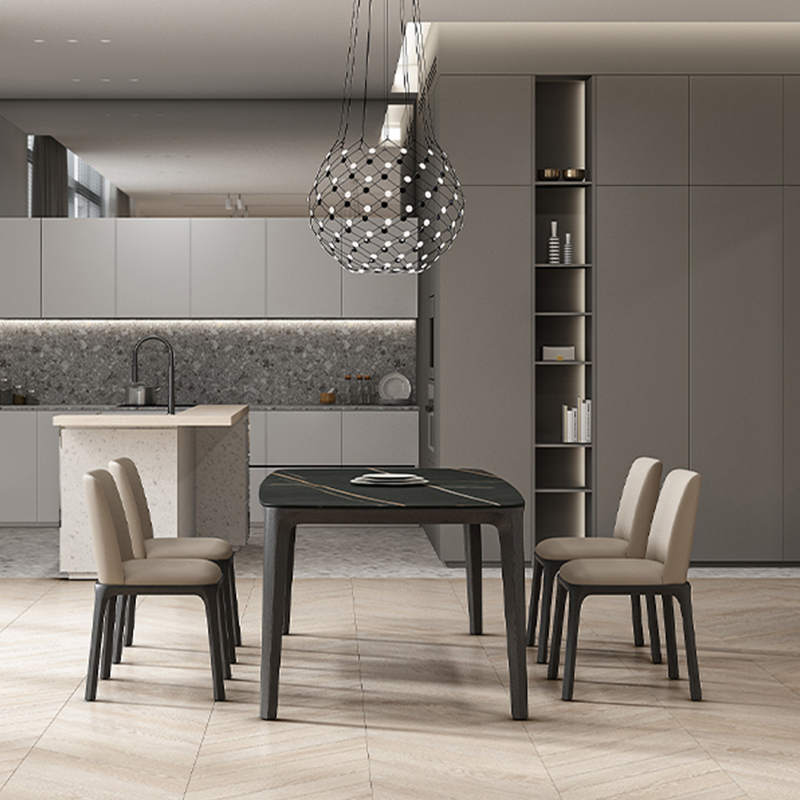
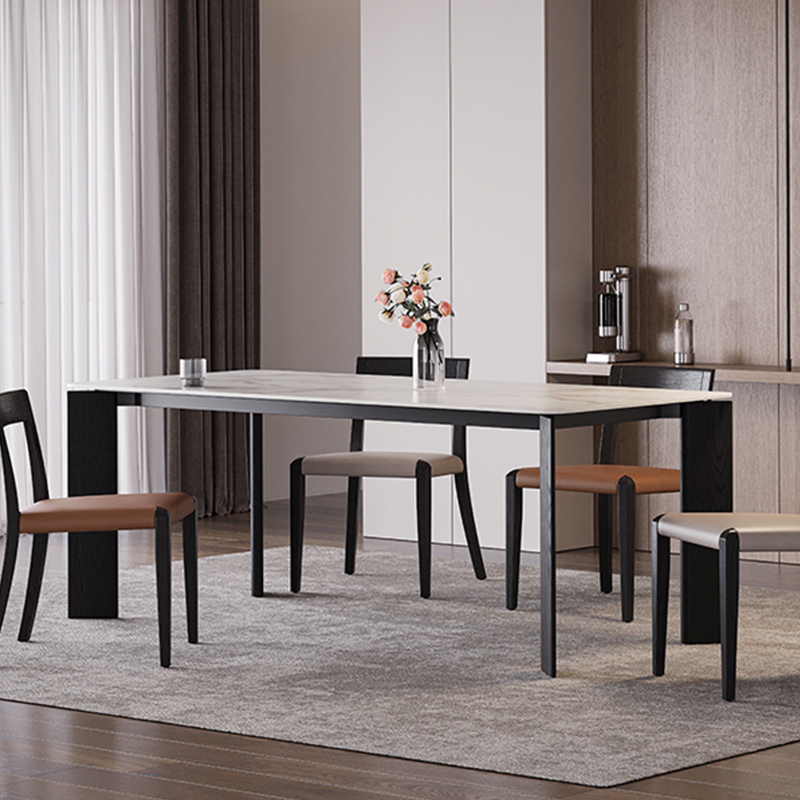
In contemporary home design, the dining table has long transcended its basic function as a dining table, becoming an aesthetic focal point and a culmination of life's rituals within the dining space. The dining table, with its ultra-thin tabletop, floating visual effect, and seemingly contradictory yet exquisitely balanced stable structure, interprets Kemu Design's profound understanding of the "less is more" philosophy. It doesn't rely on a heavy volume to assert its presence, but rather uses precise proportions, flowing lines, and restrained details to create a modern yet timeless sense of tranquility within its limited space—like a piece of paper gently lifted, yet as stable as a rock.
The essence of its design is first reflected in the tapered structure and 45-degree tilt of the legs. The seemingly slender metal or solid wood legs actually transition naturally from thick to thin, narrowing at the bottom to reduce visual weight, while the top subtly echoes the thickness of the tabletop, creating a coherent visual rhythm. This tapered shape is not merely aesthetically pleasing, but also a testament to ingenious mechanics: the thickened inner section bears the main load, while the thinned outer section creates a sense of spaciousness. The meticulously crafted 45-degree tilt not only lends the base a sculptural dynamic tension, but more importantly, it provides ample legroom for the chairs—allowing even a compact dining table in a small apartment to comfortably accommodate multiple people without feeling cramped.
Even more commendable is the "floating" gap between the tabletop and the base. Through precise joining techniques, the tabletop is not directly pressed onto the frame, but rather a subtle gap is maintained, making the entire table appear to float on the ground. This design greatly reduces the heaviness of solid furniture, allowing light to penetrate the bottom and enhancing the sense of spaciousness. Whether paired with the cool texture of natural stone or the soft grain of warm wood veneer, this "off-the-ground" posture imbues the dining table with a light and poetic quality, making it appear more open and expansive within a limited space.
The synergy between materials and craftsmanship is also crucial. While striving for an ultra-thin design, the tabletop utilizes a high-density substrate composite with a natural finish, ensuring excellent bending and deformation resistance despite its slim appearance. Connectors are concealed within the structure, preserving the overall clean lines. The surface treatment is delicate and uniform, with a warm touch, and withstands daily use and the test of time. Although the table legs and tabletop may be made of different materials, careful matching of proportions and colors achieves visual harmony, avoiding any sense of disjointedness.
Furthermore, the dining table's design is always ergonomic. Rounded edges prevent bumps and bruises; the height is ergonomically designed to fit standard dining chairs; the overall silhouette is clean and simple, making it easy to clean and maintain. It doesn't rely on elaborate decorations to attract attention, but rather integrates into various styles with restrained geometric language—whether it's Scandinavian minimalism, modern industrial style, or Eastern wabi-sabi—serving as a perfect finishing touch.
Ultimately, the allure of a dining table lies not in its thinness, but in its ability to add through subtraction—subtracting redundancy and adding thoughtfulness; subtracting bulkiness and adding lightness; subtracting noise and adding tranquility. With its most refined form, it responds to modern people's multiple desires for spatial efficiency, aesthetic purity, and quality of life.
Because in truly sophisticated design, stability doesn't need to be proven by volume, and lightness never equates to fragility. And that Weimar dining table, quietly standing in the center of the restaurant, is the most elegant material expression of this philosophy of balance.
The essence of its design is first reflected in the tapered structure and 45-degree tilt of the legs. The seemingly slender metal or solid wood legs actually transition naturally from thick to thin, narrowing at the bottom to reduce visual weight, while the top subtly echoes the thickness of the tabletop, creating a coherent visual rhythm. This tapered shape is not merely aesthetically pleasing, but also a testament to ingenious mechanics: the thickened inner section bears the main load, while the thinned outer section creates a sense of spaciousness. The meticulously crafted 45-degree tilt not only lends the base a sculptural dynamic tension, but more importantly, it provides ample legroom for the chairs—allowing even a compact dining table in a small apartment to comfortably accommodate multiple people without feeling cramped.
Even more commendable is the "floating" gap between the tabletop and the base. Through precise joining techniques, the tabletop is not directly pressed onto the frame, but rather a subtle gap is maintained, making the entire table appear to float on the ground. This design greatly reduces the heaviness of solid furniture, allowing light to penetrate the bottom and enhancing the sense of spaciousness. Whether paired with the cool texture of natural stone or the soft grain of warm wood veneer, this "off-the-ground" posture imbues the dining table with a light and poetic quality, making it appear more open and expansive within a limited space.
The synergy between materials and craftsmanship is also crucial. While striving for an ultra-thin design, the tabletop utilizes a high-density substrate composite with a natural finish, ensuring excellent bending and deformation resistance despite its slim appearance. Connectors are concealed within the structure, preserving the overall clean lines. The surface treatment is delicate and uniform, with a warm touch, and withstands daily use and the test of time. Although the table legs and tabletop may be made of different materials, careful matching of proportions and colors achieves visual harmony, avoiding any sense of disjointedness.
Furthermore, the dining table's design is always ergonomic. Rounded edges prevent bumps and bruises; the height is ergonomically designed to fit standard dining chairs; the overall silhouette is clean and simple, making it easy to clean and maintain. It doesn't rely on elaborate decorations to attract attention, but rather integrates into various styles with restrained geometric language—whether it's Scandinavian minimalism, modern industrial style, or Eastern wabi-sabi—serving as a perfect finishing touch.
Ultimately, the allure of a dining table lies not in its thinness, but in its ability to add through subtraction—subtracting redundancy and adding thoughtfulness; subtracting bulkiness and adding lightness; subtracting noise and adding tranquility. With its most refined form, it responds to modern people's multiple desires for spatial efficiency, aesthetic purity, and quality of life.
Because in truly sophisticated design, stability doesn't need to be proven by volume, and lightness never equates to fragility. And that Weimar dining table, quietly standing in the center of the restaurant, is the most elegant material expression of this philosophy of balance.